




這位傳奇投資人在這兩家傳奇企業的身上栽了跟頭

|
今年10月1日,通用電氣宣布解雇僅就職14個月的首席執行官約翰·弗蘭納里,鮮少有人不對此感到震驚,但大名鼎鼎的激進投資者納爾遜·佩爾茨就是其中之一。甚至連一直執著于跟蹤這家風光不再的企業動態的華爾街分析師都因為弗蘭納里的突然被炒而感到驚訝。然而佩爾茨對此并非事先不知情,因為他在特里安對沖基金的合伙人愛德華·加登是通用電氣的董事會成員,正是董事會炒了弗蘭納里。特里安擁有7100萬股通用電氣股票,通用電氣也因而成為佩爾茨多年來十分成功的職業生涯中損失最慘重的投資。由于該公司最近披露的負債據說受到了聯邦刑事調查,公司股票再度下跌,佩爾茨持有的股票和三年前買入時相比,已經虧損逾10億美元,跌幅達約50%。隨著弗蘭納里迅速遭到無情拋棄,佩爾茨明白變化正在醞釀中。 佩爾茨比大多數人都更能適應巨變。所謂激進投資人指的是不滿足于袖手旁觀的投資人,而在這類投資者中,佩爾茨在推動變化方面也是佼佼者。作為激進派投資者,他曾對多家公司發起過突襲,包括推動杜邦在與陶氏化學合并后再分拆為三家獨立公司。他還促使卡夫分為卡夫食品集團和億滋國際。他試圖拆分百事可樂,但失敗了。這是一位野心勃勃的投資人。 但在他諸多野心勃勃的計劃中,對通用電氣和位于其待辦事項清單頂端的另一家公司寶潔的野心可謂最大。寶潔沒有失敗,因為自佩爾茨投資以來,該公司的股價小幅上漲,而且它顯然比通用電氣更有希望。11月,寶潔宣布了重組計劃,雖然是在佩爾茨一直力推的計劃上打了折扣。一年前佩爾茨和寶潔打了美國歷史上最昂貴的代理權爭奪戰,并最終在3月加入公司董事會,但該公司遠未取得佩爾茨所希冀的成功。寶潔的股價上漲緩慢,佩爾茨的股權目前價值35億美元,是價值100億美元的特里安目前的最大投資。因此佩爾茨要想依靠寶潔擺脫通用電氣崩潰帶來的困境,寶潔的表現要有顯著好轉才行。(因為佩爾茨是寶潔的董事,而他的女婿加登是通用電氣的董事,他們拒絕了本文的采訪請求。) 通用電氣和寶潔一同毀掉了特里安此前優秀的投資記錄:過去五年,特里安的收益率高達年均11.9%,成績不俗;過去三年,是平淡無奇的年均6.5%;據特里安的一名投資者稱,截至10月,2018年的數字大約是令人沮喪的-1%。佩爾茨的大部分個人財富和高績效激進投資人的美譽都綁在了這兩家公司身上。 佩爾茨在通用電氣和寶潔公司能干成什么樣非常重要,因為這兩家知名公司不但都是佩爾茨的大難題,還擁有許多共同點。這兩家美國公司在世界各地都被譽為公司中的貴族,擁有100多年的血脈延續。兩家公司又都擁有各自獨特又不容改變的企業文化,而且這些文化都形成于公司在市場上獨領風騷的時期。但它們又都已經風光不再。依靠在兩家公司的董事會席位,特里安正不斷嘗試突破它們的界限,試圖實現更大目標。除了利用分拆、削減成本、借貸等激進投資者常用的工具,特里安和其他激進投資人相比,更愿意深入鉆研公司運營,有時他們會花費數年時間幫助公司管理層解決經營問題。由于采取顛覆性措施對老牌大公司產生更大的威脅,所以特里安能否在通用電氣和寶潔實現成功可以幫助我們判斷,如果激進投資人或任何局外人想要改變曾經統治世界的公司,在這種最高難度的經營難題中他們可以取得多少成績。 |
On Oct. 1, when General Electric announced it had fired John Flannery, its CEO of just 14 months, one of the few people not at all shocked by the news was Nelson Peltz, the legendary activist investor. Flannery’s abrupt dismissal surprised even Wall Street analysts who obsessively follow the tarnished conglomerate. Yet Peltz wasn’t caught off guard, because his partner at the Trian hedge fund, Edward Garden, is on the GE board of directors that did the deed. Trian owns 71 million shares of GE stock, qualifying GE as Peltz’s most disastrous investment in a long, successful career. He’s down over $1 billion, about 50%, since buying in three years ago, with the stock’s latest drop following word of a federal criminal investigation into recently disclosed liabilities. With the brutally swift cashiering of Flannery, Peltz now understood change was afoot. More than most, Peltz is comfortable with dramatic change. No other activist, a class of investors not content merely to watch from the sidelines, has prompted more of it. Among many activist forays, he instigated the transformation of DuPont into three independent companies after first combining with Dow Chemical. He forced the separation of Kraft into Kraft Foods Group and Mondelez International. He tried and failed to break up PepsiCo. He thinks big. He has never thought bigger than he did with GE and with the other company at the top of his to-do list, Procter & Gamble. P&G is no disaster—its shares are up slightly since Peltz invested—and it’s decidedly more promising than GE. In November, the company announced a watered-down version of the reorganization plan he had been pushing. But the company is nowhere near the success Peltz wants it to be, a year after he battled P&G in the most expensive proxy fight in U.S. history and gained a board seat in March. P&G stock is a laggard, and Peltz’s stake, recently worth $3.5 billion, is by far the biggest investment in $10 billion Trian. So Peltz needs it to perform much better if it’s to help rescue him from the GE debacle. (Because Peltz is on the P&G board, and Garden, his son-in-law, is on the GE board, they declined interview requests for this article.) Together, GE and P&G have mauled Trian’s previously sterling record: Over the past five years, Trian’s rate of return has averaged an outstanding 11.9% annually; over the past three years, a mediocre 6.5% annually; in 2018 through October, a dismal –1% or so, according to a Trian investor. Much of Peltz’s personal wealth and his reputation as a high-performing activist are tied up in those two companies. How Peltz fares with GE and P&G is important because the two famed companies share many traits besides being Peltz’s biggest problems. They’re American institutions, storied worldwide as corporate aristocrats with bloodlines stretching back more than a century. Each lives according to a unique, titanium-strength corporate culture that developed back when they were supremely dominant. Neither company has retained its stature, though. With board seats at both, Trian is pressing the boundaries of what can be accomplished at such organizations. In addition to bringing the activist’s usual tools—breakups, cost cutting, borrowing—the firm is willing to delve more deeply into operations than any other activist and sometimes spends years helping management fix a business. As disruption threatens more big, old incumbents, Trian’s success or failure will help define how much an activist, or any outsider, can hope to achieve in that hardest of managerial challenges, transforming a company that once ruled the world. |
|
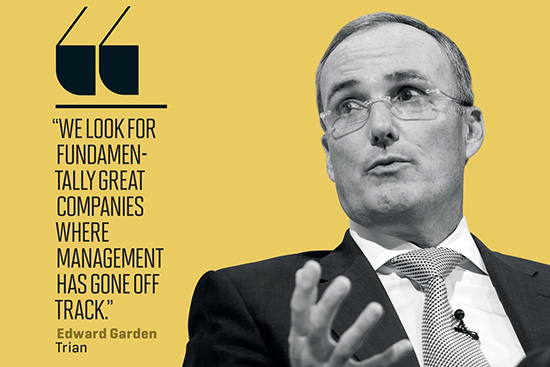
佩爾茨不是一般的激進投資人,特里安也不是一般的對沖基金,通用電氣也不是特里安的一般投資。現年76歲的佩爾茨將他的激進投資歷史追溯至20世紀80年代中期邁克爾·米爾肯以及他資助的一票企業狙擊手的鼎盛時期。 除了佩爾茨,還包括卡爾·伊坎、索爾·斯坦貝克、T·布恩·皮肯斯等。與當時的許多人不同,佩爾茨對所謂的綠票訛詐不感興趣,這種戰術指的是大量購買公司股票,威脅管理層要收購公司、迫其失業,表示如果公司高價回購綠票訛詐者所持股票就會離場。佩爾茨看到了能賺更多錢的機會。 他覺得自己能成功,因為不同于20世紀80年代的其他狙擊手,也不同于今天的激進投資人,他曾經在遠離華爾街的地方做過生意。他和他的兄弟將家里的食品分銷業務做成了一家名為弗拉格斯塔夫(Flagstaff)的冷凍食品公司;直到今天,特里安仍然熱衷于食品企業,并投資了多家食品公司,如Wendy’s、卡夫、亨氏、百事可樂等等。佩爾茨40歲時,弗拉格斯塔夫公司破產了,但他顯然從中學到了教訓。他和曾擔任弗拉格斯塔夫首席財務官的會計師彼得·梅收購了Triangle Industries,這家自動售貨機和電線公司被他們打造成了全球《財富》100強工業集團,后來在1988年被賣出。從那之后,佩爾茨和梅就一直在從事收購公司、進行業務修復再賣出公司的營生。2005年,他們和第三個合伙人、曾任瑞士信貸第一波士頓公司(Credit Suisse First Boston)投資銀行家的加登共同創立了特里安。據特里安表示,曾在佩爾茨和杜邦及寶潔的代理人之爭中為其提供支持的加州教師退休基金(State Teachers’ Retirement System)及其他機構投資者占公司全部資產的75%。 “采取修復措施,讓公司經營好轉——這就是我們的工作。”57歲的加登在3月的一次投資會議上說。“我們尋找的公司在本質上都是偉大的公司,雖然管理層在運營方面偏離軌道,但我們相信自己知道如何讓他們的業務重回正軌。”如果你覺得這聽起來更像是私募股權,特里安也同意這種看法。“我們認為自己是一種新的資產類別,”他說。“可以稱為‘流動型私募股權’或‘混合型私募股權’。”特里安的目標是獲得和私募股權同等規模的回報,但不必像私募公司那樣買下整個公司或大額股份。特里安僅擁有寶潔公司1.5%的股份和通用電氣公司0.8%的股份。通過改善目標公司運營,長期持有目標公司股權,特里安即使不使用杠桿,也能夠獲得更高收益,比僅僅依靠交易賺取更高的績效費。 2015年春天,特里安成功結束了四項投資——達能、家庭美元百貨(Family Dollar)、英格索蘭(Ingersoll-Rand)和拉扎德(Lazard),準備開展其它投資項目。通用電氣公司顯然符合特里安的投資標準——一家脫離了軌道的偉大公司,而且碰巧,時任通用電氣公司首席執行官的杰夫·伊梅爾特邀請佩爾茨買進公司股份。兩年前,伊梅爾特甚至安排佩爾茨向公司頂級管理人員講授如何削減成本。這種開放的歡迎態度幾乎聞所未聞:通常情況下,特里安的目標公司會試圖擊退入侵者,至少在最初階段會是如此。巨大的老牌工業公司不是佩爾茨的專長,但重點是伊梅爾特向華爾街承諾,通用電氣將在2018年實現每股盈利2美元,而2015年的持續性經營每股收益僅為17美分。特里安認為通用電氣甚至能表現更好,能實現2.20美元或以上的盈利;當時26美元的股價在2017年年底應該達到40到45美元之間。佩爾茨購買了23億美元的通用電氣股票并告訴伊梅爾特,特里安將確保他能夠實現每股2美元收益的承諾。 當年秋天,特里安發布了通用電氣“白皮書”,這份81頁的PPT對通用電氣的戰略和股票都提出了有力支持。的確,公司需要降低成本、削減管理層,而且可以增加借貸。但本質上,這不過是伊梅爾特“大幅改變其商業模式”的一個例子——大幅剝離GE金融業務,從公司的服務業務而非銷售中獲得收入——特里安認為這“在市場上未得到充分重視”。之后股價上漲,佩爾茨賣出了一些,撤出了近4億美元的資金,事后回想這實在是明智之舉。公司股票繼續上漲,達到金融危機前未曾企及的高度,于2016年12月沖上32.38美元。 讓人頭疼的擔憂首先出現在2016年第四季度。通用電氣的轉型十分昂貴:該公司支付的現金超過了收入,其養老基金短缺310億美元。僅2015年支付的股息就高達93億美元,比通用電氣的全部凈現金流都要多。此外,通用電氣最大的業務是為電力企業提供巨型渦輪機,相關訂單量卻未達預期。不過,這種和期望值之間的差距可以說成是可逆的,投資者似乎并不擔心。 如果當時佩爾茨對通用電氣感到擔心的話,他似乎不太可能在那個時刻對另外一個陷入麻煩的巨人再下高額賭注。就在幾個星期前,隨著他的通用電氣股價升值,佩爾茨買入了首批寶潔股票。截至2017年年初,這是特里安新近投資中最大的一筆,價值33億美元。盡管寶潔不再從事佩爾茨最喜歡的食品生意,卻仍然是他的理想目標——一家偉大卻架構過于復雜、需要整頓的公司。寶潔旗下包括吉列剃須刀、佳潔士牙膏、潘婷洗發水在內的數十個最知名品牌正在失去市場份額;全部五個產品類別都失去了競爭優勢。公司的其他投資者很高興看到佩爾茨出手,這只在牛市都停滯多年的股票在佩爾茨入場后一度飆升。 華爾街喜迎佩爾茨,但寶潔公司的領導層卻并不歡迎他的加入。該公司發布聲明,感謝全體股東,但管理層想到未來要由外人對他們指手畫腳便感到深惡痛絕。佩爾茨與首席執行官戴維·泰勒以及董事會的會議令雙方都備感沮喪。2017年6月,有消息說佩爾茨提名自己擔任公司董事時,投資者一片歡呼,股票再次大漲。但頗為諷刺的是,寶潔公司的領導層日后卻把當時股票行情的好轉當成證據,證明不需要佩爾茨的幫助他們的戰略也行之有效。 佩爾茨的請求遭到了寶潔的拒絕,所以他在7月宣布開啟代理權爭奪戰。事實證明,這種斗爭費時費錢,令各方都感到不快。泰勒警告道,佩爾茨分散了管理層的注意力,會“拖累管理層正在領導公司進行的轉型。”佩爾茨一再公開點名攻擊泰勒,并邀請前寶潔公司首席財務官克萊頓·戴利加入其陣營討伐戴利的前雇主。雙方在這場戰斗中花費巨大,高達1億美元,最終,寶潔在兩個月的股東投票中以50.01%比49.99%險勝,但二者的差距小到幾乎可以忽略。董事們意識到他們的勝利實在太過微弱,沒有足夠立場拒絕佩爾茨的請求,因此他在今年3月加入了寶潔董事會。 很難相信佩爾茨和加登在史上最大的代理權爭奪戰之外還可以關注其它事情,但他們必須得關注。正在2017年中他們和寶潔的關系惡化時,通用電氣垮掉了。 投資者們迅速失去信心,2018年每股2美元的盈利承諾顯然無法實現了。(今天華爾街預計通用電氣的每股收益為68美分。)通用電氣投資者和分析師還能記起他們意識到伊梅爾特已經完蛋了的那一刻。那是2017年5月,長期擔任公司首席執行官的伊梅爾特在佛羅里達州舉辦的年度集會上發表了講話,該集會旨在為大型電子產品公司的首席執行官與金融界進行交流提供平臺。“我從來沒有見過那樣的場景,”有人說。“他已經絕望了。你無法忍受直視他的眼睛。最簡單的基本問題就能把他生生吃掉。” 僅19天后,伊梅爾特宣布退休,讓所有人都大吃一驚。公司股票當天用20個月內的最佳表現對該新聞做出了回應。 |
Peltz isn’t a usual activist, Trian isn’t a usual hedge fund, and GE isn’t a usual investment for it. At age 76, Peltz traces his activist roots to the mid-’80s heyday of Michael Milken and the band of corporate raiders he financed. Besides Peltz, they included Carl Icahn, Saul Steinberg, T. Boone Pickens, and others. Unlike many back then, Peltz wasn’t interested in greenmail, the strategy of buying a stake, threatening management with a takeover that would cost them their jobs, and offering to go away if the company bought back the greenmailer’s stock at a higher price. Instead, he saw a chance to make even more. He felt he could do it because, unlike virtually all the other 1980s raiders and today’s activists, he had run businesses far from Wall Street. He and his brother built the family’s food distribution business into an institutional frozen food company called Flagstaff; to this day, Trian likes food companies and has invested in many—Wendy’s, Kraft, Heinz, PepsiCo, and more. Flagstaff went bankrupt when Peltz was 40, but he apparently learned from the experience. He and Peter May, an accountant who had been Flagstaff’s chief financial officer, bought Triangle Industries, a vending machine and wire company that they built into a Fortune 100 industrial conglomerate, which they sold in 1988. He and May have been buying, fixing, and selling companies ever since. In 2005, they formed Trian with a third partner, Garden, a former Credit Suisse First Boston investment banker. Institutional investors like the California State Teachers’ Retirement System, which has backed Peltz in his proxy fights at DuPont and P&G, account for about 75% of Trian’s assets, the firm says. “Fix companies and turn businesses around—that’s what we do,” Garden, 57, told an investment conference in March. “We look for fundamentally great companies where management has gone off track operationally and where we think we understand what it takes to get the business back on track.” If that sounds to you more like private equity, Trian agrees. “We think of ourselves as a new asset class,” he said. “?‘Liquid private equity’ or ‘hybrid private equity.’?” The objective is to earn PE-scale returns without having to buy a whole company or a significant stake, as PE firms typically do; Trian owns only 1.5% of P&G and 0.8% of GE. By improving operations and holding positions for years, even without leverage, Trian hopes to generate higher returns and earn bigger performance fees than it could through trading alone. In the spring of 2015, Trian was successfully exiting four investments—Danone, Family Dollar, Ingersoll-Rand, and Lazard—and was ready to invest elsewhere. General Electric certainly met the spec of a great company that had gone off track, and as it happened, GE chief Jeff Immelt had invited Peltz to buy in. Two years earlier, Immelt had even arranged for Peltz to address his top managers on the subject of cost cutting. Such an embrace was almost unheard of; Trian’s targets usually try to repel the invader, at least initially. Giant, old industrial companies weren’t Peltz’s specialty, but Immelt, crucially, had promised Wall Street that GE would earn $2 a share by 2018, up from 17¢ per share from continuing operations in 2015. Trian concluded GE could do even better, $2.20 or more; the $26 shares ought to be worth $40 to $45 by the end of 2017. Peltz bought $2.3 billion of GE stock and told Immelt that Trian would hold him accountable for keeping the $2-a-share promise. That fall, Trian published a “white paper” on GE, an 81-page PowerPoint deck powerfully endorsing GE’s strategy and its stock. Yes, the company needed to cut costs and excise management layers, and it could borrow more. But this was fundamentally a case of Immelt making “a massive change in its business model”—exiting most of GE Capital and targeting more revenue from services rather than from sales—that was “under-appreciated in the market,” Trian argued. The stock rose, and Peltz sold some, taking almost $400?million off the table, which in retrospect was a wise move. The stock continued drifting up, reaching heights it hadn’t achieved since before the financial crisis and touching $32.38 in December 2016. Nagging doubts first appeared in 2016’s fourth quarter. GE’s transformation was expensive; the company was paying out more cash than it was taking in, and its pension fund was underfunded by $31 billion. Dividend payments alone, at $9.3 billion in 2015, consumed more than GE’s entire free cash flow. In addition, GE’s biggest business, which makes gigantic turbines for electric utilities, wasn’t booking as many orders as anticipated. Still, the shortfall was arguably reversible, and investors didn’t seem worried. Had Peltz been worried about GE, it seems unlikely he would have picked that moment to make another massive bet on a troubled titan. Just weeks earlier, with his GE stake appreciating, Peltz bought his first tranche of Procter & Gamble stock. By early 2017, it was Trian’s new largest investment, worth $3.3 billion. P&G no longer marketed food, Peltz’s favorite business, but this was still his ideal target, a great company that had grown far too complex and needed shaking up. Dozens of its most famous brands—including Gillette razors, Crest toothpaste, and Pantene shampoo—were losing market share; all five of its product categories had lost significant ground to competitors. Other investors were glad to see Peltz; the stock, which had gone nowhere for years while the market surged, jumped on Peltz’s entry. Wall Street gladly greeted Peltz’s arrival, but P&G’s leaders did not. The company issued the obligatory statement about appreciating all its shareholders, but managers loathed the prospect of an outsider telling them how to do things. Peltz’s meetings with CEO David Taylor and the board frustrated both sides. When word leaked in June 2017 that Peltz had nominated himself for a board seat, investors cheered, and the stock jumped again. Ironically, P&G leaders would later cite the stock’s improved performance as evidence that their strategy was working fine without Peltz’s help. P&G rejected Peltz’s request, so in July he announced a proxy fight. The ordeal proved expensive, nasty, and long. Taylor warned that by distracting management, Peltz could “derail the transformation we’re leading.” Peltz repeatedly attacked Taylor by name and enlisted former P&G CFO Clayton Daley to campaign against his former employer. The two sides spent lavishly, as much as $100 million, on the battle, and in the end, P&G won a two-month shareholder vote by the nearly invisible margin of 50.01% to 49.99%. The directors realized the victory was too narrow to deny Peltz a seat, and he joined the board this past March. It’s hard to believe that Peltz and Garden could have focused on anything besides the world’s all-time biggest proxy fight, but they had to. Just as relations with P&G were deteriorating in mid-2017, GE was melting down. Investors were fast losing faith, and it was becoming apparent that the $2-a-share earnings promise for 2018 wasn’t achievable. (Today Wall Street expects GE earnings of 68¢ per share.) GE investors and analysts recall the moment they realized Immelt was through. It was the longtime CEO’s presentation at an annual May ritual in Florida where CEOs of big companies that make electrical products speak to the financial community. “I’ve never seen anything like it,” says one. “He was a broken man. You couldn’t stand to look him in the eye. He got eaten alive by basic, simple questions.” Just 19 days later, Immelt surprised everyone by announcing his retirement. The stock responded with its best day in 20 months. |
|
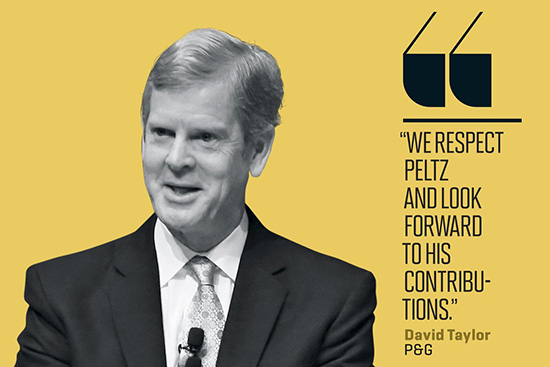
由于伊梅爾特的承諾徹底沒有兌現,特里安關于通用電氣的計劃變成了一團糟,加登和佩爾茨不再只是詢問有關董事會席位的情況,而是要求在董事會中取得一席。與此同時,佩爾茨在與寶潔的代理權爭奪戰中展示了他的兇悍。通用電氣在10月讓加登加入其董事會——不需要代理權爭奪戰。 此后,通用電氣的情況一再惡化。該公司相應采取的舉措中,最引人注目的是對董事會進行徹底重組,加登進入董事會后沒多久董事會就開始了重組。18位董事中有一半離職——這是前所未有的叛變——被三位新董事取代,其中一位是拉里·卡爾普。這立刻引發了人們的猜測:他是不是候任首席執行官?如果是這樣,背后是不是特里安在支持?該公司未就此發表評論,但在去年5月發布了一份關于本公司的情況說明書,稱“三名新董事加入董事會,其中包括丹納赫集團的前任首席執行官拉里·卡爾普”,卻未提及另外兩名董事的名字。有業內人士表示,卡爾普否認有出任首席執行官的想法——顯然證明了存在這種可能性。 從特里安的角度來看,通用電氣董事會的改革算得上是重大進展。佩爾茨進入寶潔公司董事會后,該公司也隨之取得了更多進展。代理權斗爭中的齟齬消失得無影無蹤。“我們尊重納爾遜·佩爾茨……并期待他以寶潔董事會成員的身份做出貢獻。”泰勒在一份聲明中說。佩爾茨說他“期待與泰勒緊密合作”。能看出佩爾茨正在領導變革的第一個線索是7月發布的一份證券文件,該文件披露了寶潔公司已經修改了高管的薪酬獎勵計劃,更多地將薪酬與個人績效掛鉤,而非公司業績。這是典型的佩爾茨式做法,隨后公司在11月進行了一次更加重大的變革,將公司重組為六個部門,賦予每個部門的負責人更多權力和更明晰的激勵措施。投資者為之雀躍:寶潔公司的股票三天內上漲2.2%,同期標普500指數卻下跌3%。首席執行官泰勒稱其為“公司過去20年中最重大的組織變革”。 |
With Immelt’s commitment trashed and their plan for GE now a shambles, Garden and Peltz stopped asking about a board seat and started demanding one. At that same time, Peltz happened to be demonstrating his ferociousness in the proxy fight with P&G. GE added Garden to its board in October, no proxy fight needed. From then until now, GE’s news has gone from bad to worse. Its most dramatic response has been the radical restructuring of the board, a process that began soon after Garden joined. Half the 18 directors left—an unprecedented putsch—and were replaced by three new directors, one of whom was Larry Culp. Speculation followed instantly: Was he the CEO in waiting? And if so, was Trian behind it? The firm won’t comment, but it issued a fact sheet about itself last May that observed that at GE, “three new directors joined the board including Larry Culp, former CEO of Danaher,” while omitting the names of the other two. Insiders say Culp disavowed any desire to be CEO—a sure sign the possibility existed. From Trian’s perspective, the GE board revamp was significant progress. More followed when Peltz took his seat on P&G’s board. The vitriol of the proxy fight had evaporated. “We respect Nelson Peltz … and look forward to his contributions as a member of P&G’s board,” Taylor said in a statement. Peltz said he was “looking forward to working closely” with Taylor. The first hint of Peltz-led change arrived in a July securities filing disclosing that P&G had revised its incentive pay plan for top managers, tying pay more closely to individual performance and less to corporate results. That was classic Peltz, followed in November by a far more significant change reorganizing the company into six units headed by chiefs with more power and clearer incentives. Investors cheered: P&G’s stock rose 2.2% over three days when the S&P 500 dropped 3%. CEO Taylor called it “the most significant organization change we’ve made in the last 20 years.” |
|
這是佩爾茨兩大藍籌股賭局的狀態:寶潔一直在掙扎,可能仍將繼續掙扎下去。最近的結構性重組會有所幫助,但寶潔的問題更深層。寶潔在國內長期外奉行建立大眾消費品牌的戰略與如今消費者越來越青睞小眾本土品牌的心理相悖。例如,Harry’s和Dollar Shave Club的流行成功挑戰了吉列的市場地位,讓寶潔公司大吃一驚,這對于長期引領市場的寶潔而言是全新的經歷。更廣泛地說,寶潔的文化可能會阻撓任何重大變化的出現。作為擁有181年歷史的公司,它或許會因為太過古老而難以做出調整。 寶潔公司還存在另外一個令佩爾茨不滿意的情況。佩爾茨可以充當催化劑,推動公司緩慢改善,避免出現災難,但會存在連續多年回報都十分微薄的情況。盡管如此,一直以來,佩爾茨都甘愿花費數年時間修復其他公司(比寶潔規模小得多),這些公司最終情況都出現好轉,恢復了強勢表現;Wendy's是過去十年中特里安的一場勝利,是一個正面例證。至少還有希望。 對通用電氣懷抱的任何希望都是佩爾茨2015年未實現愿景的部分殘留。他的投資是一場巨賭,賭一家擁有120年歷史的工業公司能夠適應由數字技術和相關服務引領的新時代。這個想法沒錯,但無論是通用電氣的高層還是特里安,沒有人能評估通用電氣的執行能力,結果證明它的執行能力很糟糕。此外,通用電氣和特里安因為全球市場對發電渦輪機的需求急劇下滑被打得措手不及。特里安的疏忽可以被原諒,但通用電氣不能。之后,通用電氣的全部投資者都因為公司渦輪機業務和長期護理保險業務中存在的巨額負債被曝光而情緒失控。回想起來,佩爾茨實在太過依賴伊梅爾特的保證了。對一個表現一直不怎么樣的CEO充滿信任是個錯誤。 從佩爾茨與通用電氣和寶潔公司合作的艱苦征程中,可以勾畫出激進主義的極限所在。由于不持有控制性股權,激進投資者不能對公司的日常經營進行管理,這意味著他們總是離解決公司的深層文化問題還有幾步之遙,而在充滿顛覆的當今時代,許多公司都深受文化困擾。他們能期待的最佳方案是對首次執行官的決策施加影響。但真正做出轉變的決定權在首席執行官手中,而不是激進投資者。這就是為什么他們的許多提案都是結構性的,大多是對公司進行重組或分解。背后的邏輯在于,新獨立的業務會因為激勵措施更清晰、復雜性減少、選擇增多而獲益,這種策略通常都能奏效。經過特里安分解的大多數公司已經證明,拆分后的公司更值錢。但這種戰略不利于維持偉大的具有悠久歷史的老公司。嚴酷的現實可能是,在某個時刻,它們將不再值得維持。 佩爾茨押在美國商界兩大垂暮貴族身上的賭注繼續拖累著特里安的整體表現。現在最大的問題是,在佩爾茨實現了多年令人矚目的成功后,這會是他職業生涯的轉折點,抑或只是起起落落生意場上的一個低潮。無論結果如何,我們要清楚地看到,為了能在世界上最頑固最難修復的兩家公司身上創造奇跡,以修復公司為生的佩爾茨和愛德·加登已經投入了巨額賭注。 |
So here’s the state of Peltz’s duo of big blue-chip bets. P&G has been a hell of a struggle and will likely remain one. The new reorganization is a helpful structural change, but P&G’s problems go deeper. A long-standing strategy based on building mass-market national and international brands is at odds with today’s consumers who increasingly favor smaller, niche, and local brands. The rise of Harry’s and Dollar Shave Club as successful challengers to Gillette, for example, caught P&G flat-footed—a new experience for the longtime alpha-dog company. More broadly, P&G’s culture could sabotage any significant change. At age 181, it may be too old to adjust. Peltz faces another unsatisfying scenario at P&G. He could be the catalyst for slow improvement, avoiding disaster but returning puny gains over many years. Nonetheless, Peltz has been willing to spend years fixing other companies (much smaller than P&G) that eventually turned around and came back stronger; Wendy’s, a Trian triumph over the past decade, is a good example. At least there’s hope. Any hope for GE is a shriveled remnant of what Peltz envisioned in 2015. His investment was a huge gamble on a 120-year-old industrial company adapting to a new world of digital technology and related services. It was the right idea, but no one at the top of GE or at Trian could evaluate GE’s ability to execute it, which turned out to be poor. In addition, GE and Trian were blindsided by a vertiginous plunge in global demand for electricity-generating turbines. Trian could be forgiven for missing it; GE couldn’t. And then all GE investors got crushed by revelations of mammoth liabilities in the company’s turbine business and long-term-care insurance business. In retrospect, Peltz relied way, way too much on Immelt’s assurances. Putting that much trust in a CEO who had underperformed up to then was a mistake. Peltz’s odyssey with GE and P&G outlines the limits of activism. As investors with non-controlling stakes, activists can’t run a company day-to-day, which means they’re always a couple of steps removed from solving the deep cultural problems afflicting many companies in an age of disruption. Influencing the choice of the CEO is about the best they can hope for. But the real transformation is in that person’s hands, not in the activists’. That’s why so many of their proposals are structural, mostly for reorganizing or breaking up the company. The logic is that newly liberated business will benefit from clearer incentives, less complexity, and more options, and that strategy has often worked. Most of the companies that Trian has broken up have proved more valuable in pieces. But it isn’t a strategy that preserves great old institutions. The hard reality may be that at a certain point, they aren’t worth preserving any longer. Peltz’s wager on the aging aristocracy of American business continues to wallop Trian’s performance. The great question now is whether this is a turning point for him after years of standout success or just a low point in a business full of ups and downs. As an answer plays out, the sobering truth is that he and Ed Garden, who fix companies for a living, have staked a great deal on working wonders at two of the most fix-resistant companies in the world. |
***
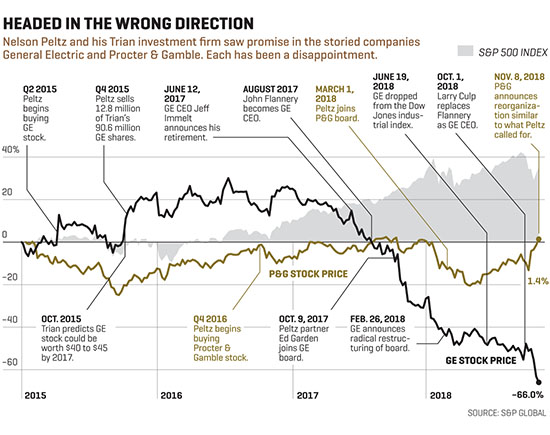
朝著錯誤的方向前進
納爾遜·佩爾茨和他的特里安投資公司認為著名的通用電氣和寶潔公司都有可觀前景。但兩家公司都令他失望了。
2015年第二季度:佩爾茨開始買入通用電氣股票。
2015年10月:特里安預測通用電氣股價能在2017年達到40至45美元。
2015年第四季度:佩爾茨從特里安所持9060萬美元通用電氣股票中出售1280萬。
2016年第四季度:佩爾茨開始買入寶潔股票。
2017年6月12日:通用電氣首席執行官杰夫·伊梅爾特宣布退休。
2017年8月:約翰·弗蘭納里出任通用電氣首席執行官。
2017年10月9日:佩爾茨合伙人加登進入通用電氣董事會。
2018年2月26日:通用電氣宣布董事會洗牌。
2018年3月1日:佩爾茨加入寶潔董事會。
2018年6月19日:通用電氣被道瓊斯工業指數除名。
2018年10月1日:拉里·卡爾普取代弗蘭納里成為通用電氣首席執行官。
2018年11月8日:寶潔宣布類似于佩爾茨提出的重組計劃。
***
|
(財富中文網) 本文的另一個版本作為《2019年投資者指南》的一部分刊載于2018年12月1日的《財富》雜志。 譯者:Agatha |
A version of this article appears in the December 1, 2018 issue of Fortune, as part of the “2019 Investor’s Guide.” |